What Is Alternative Investing? + How to Build a Portfolio Beyond Stocks
What is Alternative Investing?
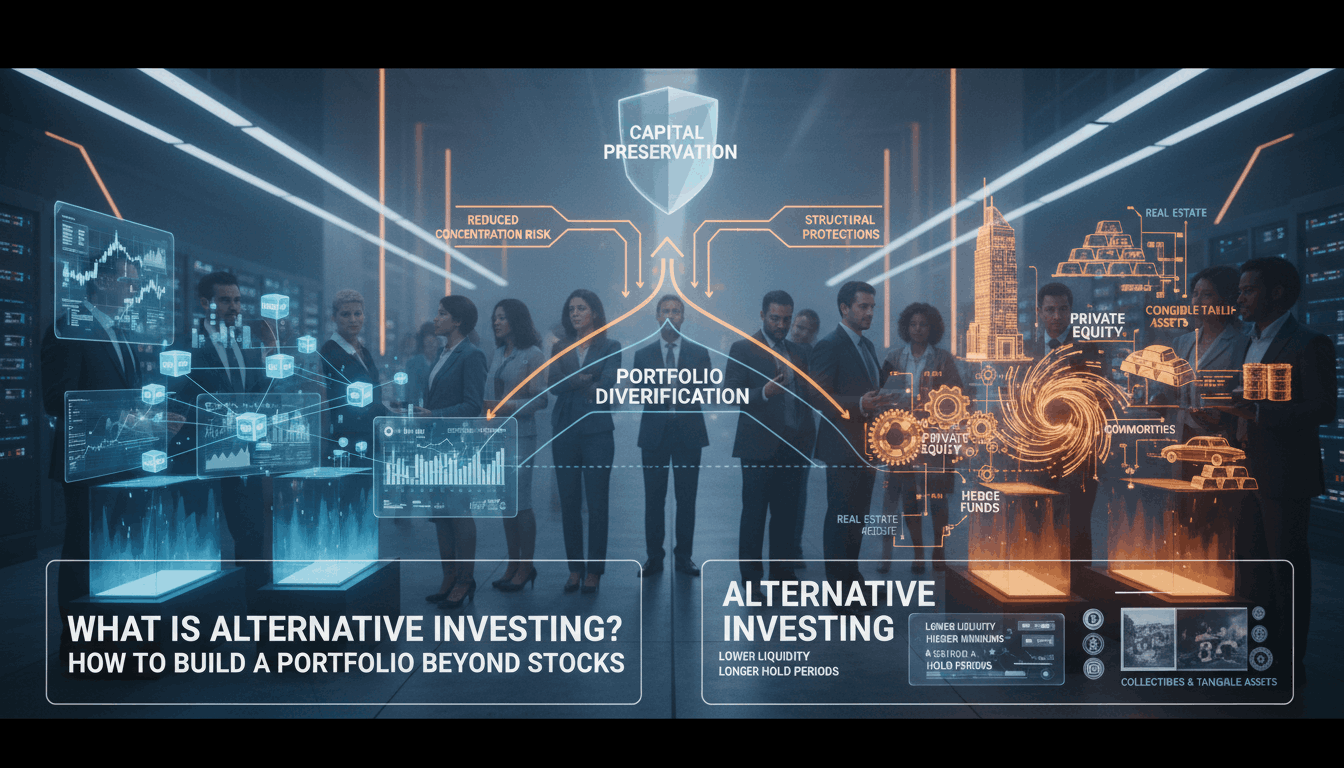
Alternative investments are asset classes that fall outside the traditional categories of stocks, bonds, and cash. These investment vehicles include real estate, private equity, hedge funds, commodities, collectibles, and other tangible or financial instruments that operate with different characteristics than publicly traded securities. Lower liquidity, higher minimum investment requirements, and distinct regulatory frameworks separate them from conventional investments.
Traditional securities trade on public exchanges with daily pricing and ready access. Alternative capital investments work differently. They involve longer holding periods and more complex valuation methods. These assets require investors to commit capital for extended timeframes, ranging from several years to a decade or more, depending on the specific investment structure. The illiquid nature means investors cannot convert their holdings to cash quickly without accepting significant discounts or waiting for predetermined exit events.
These investment opportunities are available only to sophisticated investors and high-net-worth individuals who meet specific financial thresholds. Regulatory bodies establish these requirements based on the basic contours that such investors possess the financial resources and knowledge to assess complex investment structures and withstand potential losses. The minimum investment amounts for many alternative options exceed those of traditional securities and start at six or seven figures for institutional-grade opportunities.
The structural complexity of alternative investments requires a full picture of multiple risk factors. Capital protection mechanisms, legal enforceability across jurisdictions, and governance frameworks play central roles in determining the security of invested funds. Investors must get into how their capital receives protection under various scenarios, where risks concentrate within counterparties or specific jurisdictions, and what occurs during default situations. These considerations extend beyond the simple risk-return calculations common in traditional equity and fixed-income analysis.
Alternative investments involve structures that require transparent reporting, trustee oversight, and clear payment controls. The assessment process examines whether collateral backing exists as enforceable claims rather than vague asset associations. Independent governance mechanisms provide visibility into fund usage, cash flow patterns, and covenant compliance. These protective elements distinguish credible alternative investment structures from those that offer marketing appeal without substantive investor protections.
Performance measurement for these assets is different from traditional benchmarks. Rather than comparing against stock market indices, alternative investments may focus on absolute returns, capital preservation targets, or specific yield objectives that line up with their unique risk profiles and investment horizons.
Types of Alternative Investments
Several distinct asset categories comprise the alternative investment landscape. Each has unique risk profiles, liquidity constraints and return mechanisms.
Real Estate
Real estate investments cover direct property ownership, real estate investment trusts (REITs) and private real estate funds. Direct property acquisitions require substantial capital commitments. They involve responsibilities for property management, tenant relations and maintenance obligations. Private real estate funds pool investor capital to acquire commercial properties, residential developments or land holdings. These funds operate with multi-year lock-up periods. The investments generate returns through rental income streams and property appreciation. Valuations are conducted at intervals rather than through daily market pricing.
Private Equity
Private equity represents ownership stakes in companies not listed on public exchanges. These investments occur through buyout funds, growth capital funds or venture capital vehicles that target businesses at various development stages. Fund managers acquire controlling or substantial minority positions and implement operational improvements. They exit through sales or public offerings after holding periods of five to ten years. The capital commitment structure requires investors to contribute funds as called rather than providing lump-sum investments upfront. Distributions occur as portfolio companies achieve successful exits.
Hedge Funds
Hedge funds use various strategies, including long-short equity positions, market-neutral approaches, event-driven tactics and global macro plays. Fund managers possess latitude to use derivatives and short selling to generate returns independent of broad market movements. These vehicles charge management fees based on assets under administration plus performance fees on profits above specified thresholds. Redemption terms vary, with some funds permitting quarterly withdrawals while others impose annual or multi-year restrictions.
Commodities
Commodity investments provide exposure to physical goods, including precious metals, energy resources, agricultural products and industrial materials. Investors access these markets through futures contracts, exchange-traded products or direct physical ownership. Price movements respond to supply-demand dynamics, geopolitical events, weather patterns and currency fluctuations rather than corporate fundamentals. Storage costs, contango effects and rollover mechanics influence returns in futures-based commodity positions.
Collectibles and Tangible Assets
Collectibles cover fine art, rare wines, vintage automobiles, stamps, coins and other items valued for their lack of availability, historical significance or aesthetic appeal. These assets have no standardised pricing mechanisms and require specialised knowledge for their authentication and valuation. Transaction costs include dealer commissions, auction house fees, insurance premiums and storage expenses. Authentication risks, condition deterioration and narrow buyer pools create liquidity challenges distinct from financial securities.
Why Add Alternative Investments to Your Portfolio?
Portfolio diversification serves as the main reason for adding these asset classes. Traditional stock-bond allocations expose investors to related market movements and systematic risks that concentrate in public securities. Alternative capital investments introduce exposure to returns driven by different economic factors, operating cycles and valuation mechanisms than those affecting publicly traded equities and fixed income.
Capital preservation is the foundational objective for many investors who allocate to alternatives rather than pursue maximum returns. This approach prioritises downside protection and principal security over aggressive growth. Conservative investors focus on how capital receives protection under adverse scenarios. They look at the specific mechanisms that safeguard invested funds when markets decline or individual investments underperform. The emphasis moves from potential upside to understanding what happens during default situations, who receives payment priority and how enforcement occurs in different jurisdictions.
There's another reason for alternative allocations: reducing concentration risk. Portfolios heavily weighted toward public equities in single geographic markets carry exposure to regional economic cycles, regulatory changes and currency fluctuations. Alternatives provide access to returns from private markets, physical assets and specialised strategies that operate independently of stock market valuations. This geographic and asset class dispersion reduces dependency on any single market's performance.
The structural protections embedded within certain alternative investments attract investors who value enforceability over yield promises. Rather than accept marketing claims about projected returns, investors look at whether collateral backing exists as legally enforceable claims, whether independent trustees provide oversight and whether transparent reporting mechanisms enable monitoring of fund usage and covenant compliance. These governance frameworks offer visibility into cash flow patterns and early warning signals regarding potential issues.
Investors seeking stability in portfolio values and income streams are motivated by the predictable behaviour of capital. Many alternatives operate with periodic valuations and predetermined distribution schedules, unlike publicly traded securities, which experience daily price fluctuations driven by market sentiment. This stability proves valuable for investors with specific liquidity needs or those seeking to avoid the psychological pressures of constant market volatility. The focus remains on assets that perform consistently across various economic conditions, rather than on those that promise exceptional gains during favourable periods.
How to Build a Portfolio Beyond Stocks
Building an allocation that goes beyond traditional securities needs systematic review across multiple dimensions. Start with clear objective definition and progress through structural assessment.
Determine Your Investment Goals
Your foundation rests on establishing whether capital preservation or yield generation takes priority. Investors focused on preservation examine how capital is protected under adverse conditions. They ask what enforcement mechanisms exist across jurisdictions and who holds payment priority during default scenarios. Those prioritising income examine distribution schedules, payment mechanics, and the sustainability of projected yields. The arrangement between stated objectives and actual capital deployment determines whether an allocation serves its intended purpose or creates exposure to unintended risks.
Assess Your Risk Tolerance
Risk evaluation goes beyond standard volatility measures to cover structural vulnerabilities within specific investment vehicles. This analysis gets into where risks concentrate, whether in counterparties, jurisdictions, or underlying assumptions about asset performance. You must understand what happens during default situations. This includes which parties receive payment and through what legal mechanisms enforcement occurs. The assessment identifies conditions under which capital protection breaks down. This allows you to determine whether you possess the financial capacity and temperament to withstand potential adverse outcomes specific to illiquid positions.
Start Small and Diversify
Your initial exposure should remain limited relative to overall portfolio size. This allows you to learn about operational mechanics, reporting cadences, and liquidity constraints before committing larger amounts. Diversification across multiple alternative categories reduces concentration risk within any single strategy or asset class. This approach recognises that alternatives themselves carry distinct risk profiles. Private equity differs from real estate or commodities in terms of return drivers, holding periods, and capital deployment patterns.
Choose the Right Investment Vehicle
Vehicle selection demands scrutiny of legal structures, governance frameworks, and investor protections embedded within offering documents. The review process determines whether collateral backing exists as enforceable claims rather than marketing assertions. It checks whether independent trustees provide oversight and transparent reporting. It also verifies whether payment controls enable monitoring of fund usage and covenant compliance. Vehicles lacking these structural protections may offer attractive yield projections but expose capital to unsecured risks without recourse mechanisms during adverse events.
Risks to Consider with Alternative Investments
Historical failure patterns reveal the specific vulnerabilities that distinguish high-risk alternative structures from those with genuine investor protections. Recent defaults in UK real estate and litigation-backed securities, including Godwin 8, 79th Group, Fenchurch, and Social Housing Group, demonstrate how asset-backed investments can collapse when structural safeguards prove inadequate.
Unsecured exposure with vague collateral links represents the first common oversight in failed alternative investments. Many notes marketed with asset backing provide no enforceable claim on real assets and create an illusion of security without legal substance. The collateral remains unenforceable in different jurisdictions or exists as a marketing concept rather than a ring-fenced asset pool that is segregated from issuer operations.
Weak oversight and absent independent governance compound these structural deficiencies. Investors in failed instruments lack visibility into fund usage, cash flow patterns, or covenant breaches until losses materialise. Monitoring becomes impossible without independent trustees, transparent reporting mechanisms, or payment controls. Structures with active governance enable early detection of deteriorating conditions through regular reporting and oversight protocols.
Issuer-led marketing without intermediary risk filtration creates the third vulnerability. Direct promotion by issuers, absent third-party due diligence, allows structures with inadequate protections to reach investors. The absence of independent analysis means structural flaws, weak enforceability, and misaligned incentives remain unidentified until defaults occur.
Risk concentration shows itself in multiple dimensions beyond asset selection. Counterparty risks arise when payment depends on specific entities without backup mechanisms. Jurisdictional risks emerge from legal frameworks that fail to enforce investor claims. Assumption risks stem from projections about asset performance, market conditions, or exit opportunities that prove unfounded under stress scenarios. These concentration points require examining how capital protection breaks down under adverse conditions, who receives payment priority during defaults, and what enforcement mechanisms exist in relevant jurisdictions.
FAQs
Q1. What are examples of alternative investments beyond traditional stocks and bonds?
Alternative investments include real estate (direct property ownership and REITs); private equity (ownership stakes in non-public companies); hedge funds (using diverse strategies like long-short positions); commodities (precious metals, energy, and agricultural products); and collectibles (fine art, rare wines, and vintage automobiles). Each category has unique risk profiles, liquidity constraints, and return mechanisms that differ from publicly traded securities.
Q2. Why should investors consider adding alternative investments to their portfolio?
Alternative investments provide portfolio diversification by introducing exposure to returns driven by different economic factors than public securities. They help reduce concentration risk, offer potential capital preservation benefits, and can provide more predictable income streams. These assets operate independently of stock market valuations, reducing dependency on any single market's performance and offering protection during market downturns.
Q3. What are the main risks associated with alternative investments?
Key risks include illiquidity (inability to quickly convert holdings to cash), higher minimum investment requirements, complex valuation methods, and longer holding periods. Structural vulnerabilities can include unsecured exposure with weak collateral backing, absent independent governance and oversight, counterparty risks, and jurisdictional enforcement challenges. Many alternatives also lack standardised pricing mechanisms and transparent reporting, especially when compared to traditional securities.
Q4. How should beginners start building an alternative investment portfolio?
Start by clearly defining your investment goals, whether you prioritise capital preservation or yield generation. Assess your risk tolerance and financial capacity to withstand potential losses in illiquid positions. Begin with small allocations relative to your overall portfolio size to gain familiarity with operational mechanics and reporting. Diversify across multiple alternative categories to reduce concentration risk, and carefully evaluate the legal structures and investor protections of each investment vehicle.
Q5. Who typically has access to alternative investments?
Alternative investments are primarily restricted to sophisticated investors and high-net-worth individuals who meet specific financial thresholds established by regulatory bodies. These requirements exist because alternative investments often require substantial capital commitments (frequently starting at six or seven figures), specialised knowledge to evaluate complex structures, and the financial capacity to withstand potential losses and extended holding periods.