Expat Wealth Management Checklist: What Every HNWI Needs to Know Before Moving Abroad

Your strategy for managing wealth as an expat determines whether your international moves preserve or jeopardise your financial security. High-net-worth individuals face unique challenges when relocating abroad. You must navigate multiple tax jurisdictions and restructure investment portfolios for global mobility. Planning becomes critical in this context.
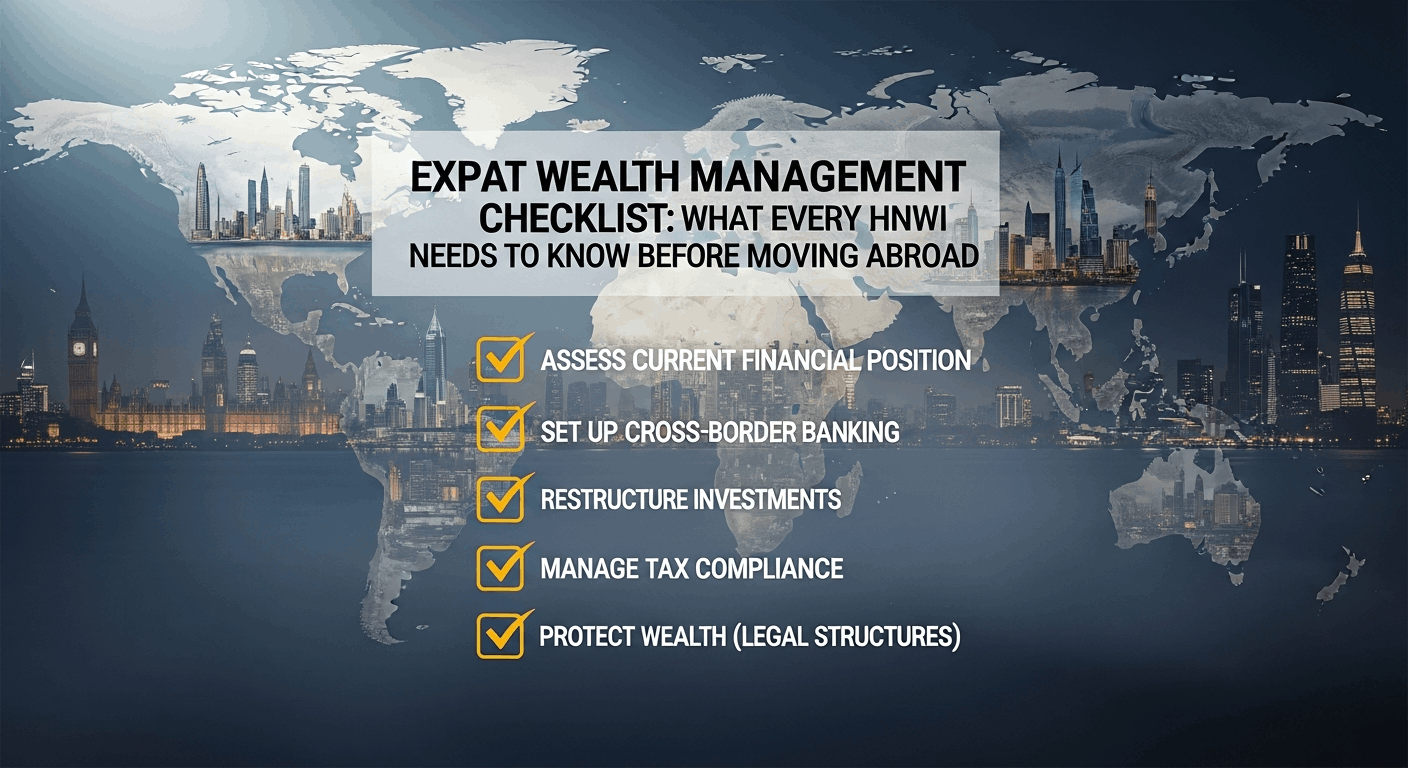
This checklist covers everything in your pre-move preparation. You need to assess your current financial position and set up cross-border banking infrastructure. Restructure your investments, manage tax compliance, and protect your wealth through appropriate legal structures.
Understanding Your Current Financial Position Before the Move
A complete financial inventory is the foundation of successful expat wealth management. You cannot build a plan that survives the move without knowing exactly what you own, where it sits, and how it connects across borders.
Map all your assets and account locations
Start by listing every financial provider and login you hold. Banks, brokerages, pension platforms, private fund portals, crypto exchanges, and employer plans all need documenting. Record the jurisdiction, base currency, and legal owner for each account.
Include private company shares, carried interest positions, employer stock, and real estate holdings in this inventory. Digital assets like emails, online banking credentials, and cryptocurrency also require proper documentation. Note who can access each account if you cannot—your spouse or executor needs this information in an emergency.
Account sprawl creates missed beneficiary updates, duplicated holdings, and unmanaged currency exposure. You will struggle to measure the system if your net worth lives across five banks and three brokers. Combine where practical and safe, but keep separate accounts when regulation, employer plan rules, or asset protection requires it.
Identify tax residency triggers in your destination country
Tax residency rules vary significantly by jurisdiction. Some countries count physical presence days, while others look at factors like a permanent home, a centre of economic interest, or a habitual abode. You need to understand the specific triggers for your destination country before you relocate.
Create a one-page timeline documenting where you lived, worked, and held tax residency over the last three to five years. Add expected moves in the next 12 to 24 months. This timeline helps qualified cross-border tax advisors identify potential overlaps or gaps in your residency status.
Residency changes affect account eligibility, reporting obligations, and withholding rates. Timing matters because these changes can happen quickly after a move. Your tax footprint summary should include current residency position, expected moves, major income sources, and account types.
Calculate your total liquid net worth
Please select a reporting currency and convert all balances on a monthly basis. This practice allows you to track drift in savings rates and risk exposure. Measure your holdings in the currency you will spend, not your largest account currency.
Define clear liquidity tiers: daily cash, 12-month runway, and long-term capital. Match each tier to the right account type and settlement speed. Your immediate bucket should hold three to twelve months of spending in cash or cash equivalents with a strong bank. Plans for one to three years belong to high-quality, short-duration bonds or money market funds that you can sell quickly.
Knowing your liquid position prevents forced selling during market downturns or currency swings. Include all available funds, but exclude illiquid commitments like private equity, venture funds, or deferred compensation that cannot be tapped quickly.
Review existing financial commitments and liabilities
Please ensure that you document all debts and liabilities you have. Mortgage statements, margin loans, credit lines, and repayment schedules all require review. Note the currency denomination and interest type—fixed or floating—for each commitment.
Floating-rate debt in a foreign currency creates dual exposure: interest costs can rise while exchange rates move against you. Understanding these obligations helps you structure assets to match liabilities according to currency.
Gather recent tax returns, current-year estimates, and any tax residency certificates you have used. Collect statements from the past twelve months for all accounts. This documentation pack is the foundation for any advisor review and ensures clean data enters your planning process.
Setting Up Your Cross-Border Banking and Currency Infrastructure
Banking infrastructure built for a single country will fail when you operate across borders. The accounts, payment methods, and currency systems you set up now determine whether routine transactions go smoothly or cause friction at every turn.
Choose banking partners that operate in multiple jurisdictions
Select institutions that maintain physical presence and regulatory licences in multiple countries. Third-party custody at reputable brokers or banks protects your assets better than arrangements where an advisor or affiliate holds your funds. To cite an instance, Moventum offers custodial services recognised across many jurisdictions.
Avoid banking relationships where you must wire money to an advisor. Look for partners that provide combined reporting across all your holdings, whatever the location. The institution should define who sees your data, retention periods, and how it handles KYC and source-of-fund checks.
Open multi-currency accounts before you relocate
Multi-currency accounts allow you to hold, receive, and send funds in different currencies without forcing conversions at unfavourable rates. Open these accounts while you still hold clear residency status in your current country. Moving first and then trying to open accounts as a non-resident creates complications and delays you don't need.
Choose solutions offering online and mobile banking services with low or zero international transaction fees. Your banking platform should support the currencies you earn, spend on, and invest in. Settlement speed matters. Know how long transfers take between currencies and whether weekend or holiday delays affect your cash flow.
Set up international payment rails and transfer methods
Identify where income lies, where bills leave and where investment activity happens. Add foreign exchange conversion rules that are explicit. Specify who converts, when they convert and at what spread. This practice prevents currency exposure that changes your risk profile without your knowledge.
Turn off automatic conversions that trigger at poor rates. Establish scheduled transfers or threshold-based rules that provide you control over timing instead. Payment rails should accommodate both regular transfers and larger, less frequent movements without excessive fees or delays.
Establish your base currency for financial reporting
Convert income and recurring expenses to a single reporting currency monthly. This consistency allows you to measure savings rate and burn rate across jurisdictions. Your base currency should match where you expect to spend long-term, not where your largest account sits.
Track cash flow in this home currency even as you maintain accounts in multiple denominations. Then you can spot drift in your financial position before it becomes problematic. Software and spreadsheets work well, provided you update them with actual exchange rates, not estimates.
Plan for foreign exchange exposure management
Separate the three elements: the currency of spending, the currency of assets, and the currency of liabilities. Decide what must be hedged and what can float based on your future obligations. Put target ranges in writing. Target allocation plus or minus 10 percentage points for each major currency works as an example.
These written bands prevent foreign exchange bets after a move or compensation change. Currency exposure should stay intentional. If you cannot state your currency allocations from memory, your exposure management needs refinement before you relocate.
Restructuring Your Investment Portfolio for Global Mobility
A portfolio designed for one country rarely survives changes, currency shifts, and liquidity demands across borders. Successful expat wealth management requires you to rebuild your investment structure around mobility, not geography.
Build a three-tier liquidity structure
Segment your assets into three distinct buckets based on time horizon and accessibility. Your immediate tier holds three to twelve months of spending in cash or cash equivalents with a strong bank. This bucket protects you from forced selling when markets drop or currency rates move against you.
The planned tier covers one to three years of known needs through high-quality, short-duration bonds or money market funds that you can sell without price volatility. School fees, property deposits or planned relocations belong here. Your long-term bucket contains the growth portfolio—global equities, longer-duration bonds and alternatives, if appropriate for your situation. This structure ensures cash availability without sacrificing growth potential.
Define currency exposure bands for each financial goal
Retirement expenses, school fees and property purchases often occur in different currencies. Match each goal to its spending currency, then measure portfolio risk in those terms rather than your largest account currency. Write down the percentage of assets you want exposed to each major currency that funds your future liabilities.
Set ranges you can state from memory—target allocation plus or minus 10 percentage points, to name just one example. These written bands prevent foreign exchange bets you make by accident after a move or bonus payment. Your currency allocation must reflect all three exposures: earning in US dollars, spending in euros, and planning retirement in pounds sterling. Currency risk stays manageable when you separate currency of spending, currency of assets and currency of liabilities as distinct planning elements.
Switch to portable investment vehicles
Choose liquid, diversified instruments that work across jurisdictions. UCITS ETFs, a European fund structure used around the world, offer broad market exposure with clean custody and transparent reporting. Large, low-cost mutual funds provide similar benefits where available.
Avoid complex insurance wrappers unless you can explain the costs, lock-ups, and cross-border reporting requirements in plain language. These products create account eligibility problems when you change residency. Portable building blocks remain investible, whatever your next move.
Set concentration limits for single positions
Cap single-stock exposure and employer stock positions to prevent one holding from dominating your net worth. Treat your primary residence and private business equity as concentrated positions when you size public market risk. You won't exacerbate the risks you already face through property ownership or business operations.
Founders and senior executives face particular exposure when employer stock, carried interest or private company shares represent substantial wealth. Concentrated positions require limits you can state from memory, balanced against diversified holdings.
Establish clear rebalancing rules and triggers
Set rebalancing on both calendar dates and threshold bands before markets move. Rebalance semi-annually or annually and when an asset class drifts more than 5 percentage points from its target allocation. Execute rebalancing inside accounts with the least friction and the cleanest tax reporting to minimise costs and compliance burdens. These rules prevent decision-making by headline and keep your portfolio arranged with written targets across multiple jurisdictions.
Navigating Tax Compliance and Reporting Obligations
Tax compliance failures trigger penalties more often than investment losses for internationally mobile individuals. Reporting obligations multiply when you hold assets in different countries, and residency status determines which rules apply to your situation.
Understand your tax residency status in both countries
Establish where you hold tax residency before and after your move. Countries apply different tests—some count physical presence days and others assess the permanent home location or center of economic interests. Overlapping residency in two jurisdictions creates dual reporting obligations and potential double taxation.
Keep your one-page tax footprint summary current: residency status, expected moves, major income sources and account types. This document prevents gaps in your planning and helps identify transition periods when multiple tax regimes apply at once.
Identify all cross-border reporting requirements
Expat wealth management needs awareness of multiple reporting systems. The CRS (Common Reporting Standard) aids the automatic exchange of financial information between countries. FATCA applies to US-connected individuals and requires disclosure of foreign financial accounts and assets.
Local foreign asset declarations create jurisdiction-specific obligations. Spanish tax residents with overseas assets above certain thresholds must file Modelo 720, Spain's foreign asset information return. The form is filed in the first quarter of the following year based on asset values held on 31 December. France maintains similar foreign account reporting requirements.
Trust or company reporting adds complexity where applicable. Each structure carries distinct disclosure obligations, depending on ownership, control, and beneficiary arrangements.
Gather documentation for foreign asset declarations
Verify that you have all the necessary documentation for assets held abroad. Collect recently filed tax returns, current-year estimates, and any tax residency certificates or treaty forms you have used. Bank and broking statements from the past twelve months are the foundations for accurate reporting.
Prepare ahead for filing deadlines in the new year. Gathering statements and valuations before year-end prevents rushed submissions and will provide accurate reporting when deadlines arrive.
Review tax treaty benefits and double taxation relief
Tax treaties between countries often provide relief mechanisms that prevent the same income from facing tax in multiple jurisdictions. Understanding these benefits requires reviewing the treaty between your countries of residency. Relief may take the form of tax credits, exemptions or reduced withholding rates.
Coordinate with qualified cross-border tax advisors
Share your complete tax footprint summary with qualified cross-border tax professionals before opening new structures or making major financial changes. Coordination prevents costly mistakes that emerge from misunderstanding how different tax regimes interact. Cross-border tax advice requires specialists familiar with both jurisdictions and the treaties connecting them.
Protecting Your Wealth Through Proper Legal Structures
Legal structures protect your wealth when tax planning and investment allocation cannot. Cross-border estate planning addresses forced-heirship rules, conflicting inheritance systems, and jurisdictional gaps that emerge when assets span multiple countries.
Update or create valid wills that work internationally
Cross-border estate planning proves especially necessary where forced-heirship rules or different inheritance tax systems apply. Draft separate wills for assets in different jurisdictions, or create a single international will that accounts for varying legal frameworks. Keep signed documents available in secure locations.
Review and adjust beneficiary designations on all accounts
Confirm beneficiaries on every account. Insurance policies, retirement plans, pension schemes, and investment accounts all require current designations. Outdated beneficiary information creates transfer complications that proper account titling prevents.
Think about powers of attorney in relevant jurisdictions
Document powers of attorney or local equivalents in each country where you hold major assets. Specify who can access accounts and make decisions if you cannot. This planning will provide continuity during emergencies or incapacity.
Assess whether trusts fit your cross-border situation
Trusts may supplement wills, though they carry distinct reporting obligations depending on ownership and control structures. Determine whether trust arrangements match your cross-border requirements before implementation.
Get detailed international insurance coverage
International health insurance offers global coverage that protects you while travelling. Review policies and make sure they accommodate your mobile lifestyle across jurisdictions.
Digitise and safeguard all critical financial documents
Store identification, bank statements, investment records, insurance policies, and tax documents in password-protected cloud storage that's secure. Encrypted vaults such as 1Password or Bitwarden protect sensitive information. Maintain a one-page access sheet documenting who can retrieve these files in an emergency.
Most people find it complicated to plan for the fate of their wealth after death. But it is necessary if you want your loved ones protected and your wishes honoured. Expat Fiduciary has helped clients navigate the complicated process of estate planning and ensure a smooth transition of wealth. You are welcome to contact us and we 'll be in touch with a discovery call as soon as possible.
Final Thoughts
Your financial security depends on addressing these elements before you relocate. In fact, each section of this checklist connects to preserving and growing your wealth across borders. You need to map your current position, establish banking infrastructure, restructure investments, manage tax compliance, and protect assets through legal structures that work together.
The complexity multiplies when you operate in multiple jurisdictions.
Start this process months before your move, not weeks. Your international transition will succeed when planning matches the scale of your wealth and the complexity of your situation.